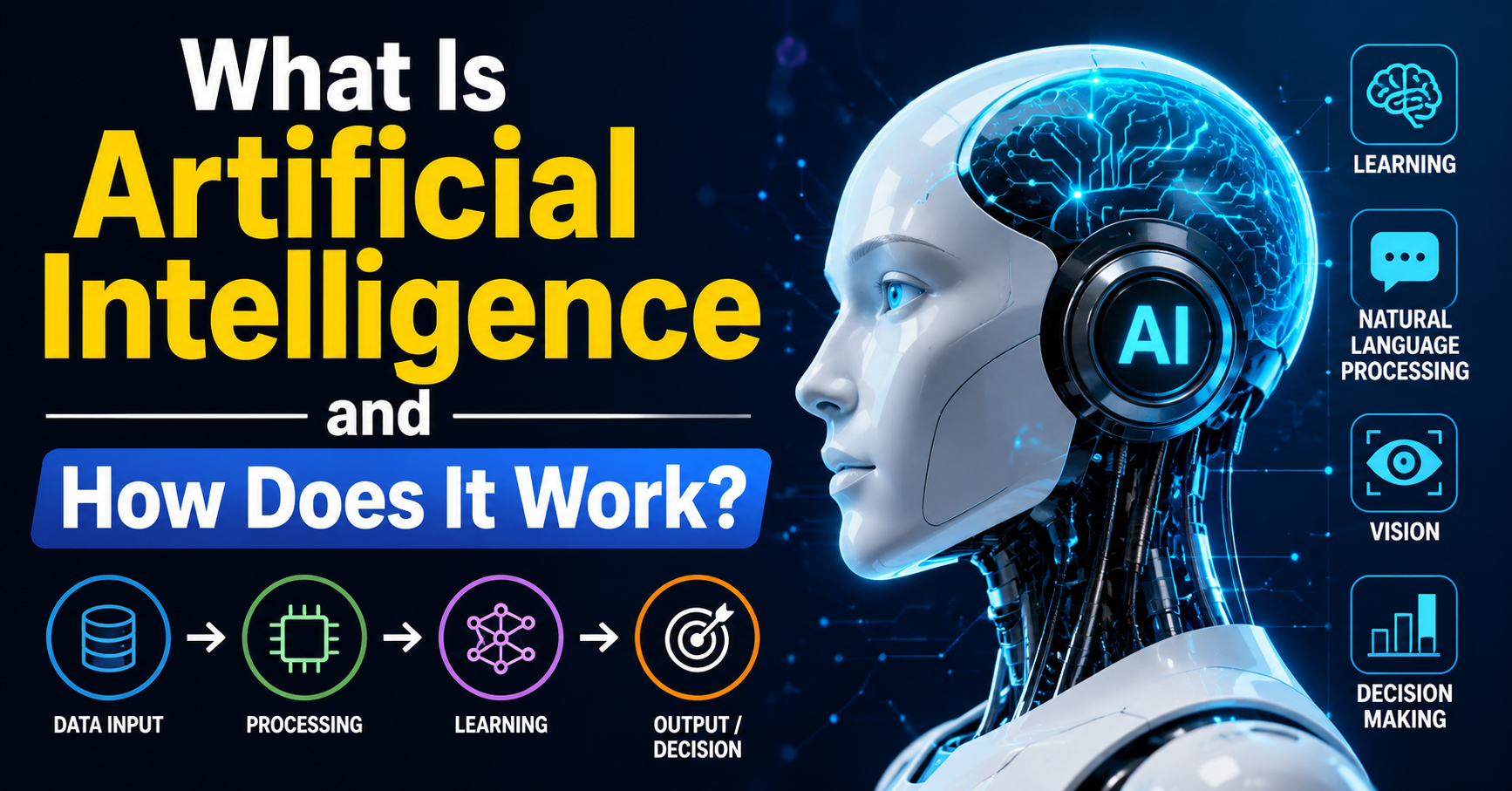
Artificial Intelligence (AI) is one of the most important technologies of the modern world. Today, Artificial Intelligence is used in smartphones, search engines, online shopping platforms, healthcare systems, and even self-driving vehicles. Although many people use AI-powered tools every day, they may not fully understand what Artificial Intelligence is and how it works. In simple terms, AI enables machines and computer systems to perform tasks that usually require human intelligence, such as learning, problem-solving, decision-making, and understanding language.
As technology continues to advance, Artificial Intelligence is becoming a major part of our daily lives. From virtual assistants to recommendation systems, AI helps businesses improve efficiency and provides users with better experiences.
What Is Artificial Intelligence?
Artificial Intelligence is a branch of computer science that focuses on creating systems capable of performing tasks that normally require human intelligence. These tasks include:
- Learning from data
- Recognizing patterns
- Understanding language
- Solving problems
- Making decisions
- Identifying images and objects
Instead of following only fixed instructions, AI systems can analyze information and improve their performance over time.
For example, when you use a streaming platform that recommends movies based on your interests, Artificial Intelligence is working behind the scenes to analyze your viewing habits and suggest relevant content.
A Brief History of Artificial Intelligence
The concept of Artificial Intelligence has existed for decades. Researchers began exploring the possibility of creating intelligent machines in the 1950s.
Here is a simple timeline:
| Year | Development |
|---|---|
| 1956 | The term “Artificial Intelligence” was officially introduced |
| 1960s-1970s | Early AI research and experiments |
| 1980s | Growth of expert systems |
| 1997 | IBM’s Deep Blue defeated world chess champion Garry Kasparov |
| 2010s | Rapid growth of machine learning and deep learning |
| Present | AI is used in healthcare, education, business, and everyday technology |
Today, AI has become one of the fastest-growing fields in technology.
How Does Artificial Intelligence Work?
Artificial Intelligence works by collecting data, processing information, identifying patterns, and making predictions or decisions based on what it learns.
The basic process usually involves the following steps:
Data Collection
AI systems require large amounts of data to learn effectively. This data can come from:
- Images
- Videos
- Text documents
- Audio recordings
- User interactions
- Sensors
The quality of data directly affects the accuracy of the AI system.
Data Processing
Once the data is collected, the AI system organizes and analyzes it. The goal is to identify useful patterns and relationships within the information.
For example, an AI system trained to recognize cats in photos studies thousands of cat images to learn common features such as ears, eyes, and body shapes.
Machine Learning
Machine Learning is a key component of Artificial Intelligence. It allows computers to learn from data without being explicitly programmed for every situation.
Instead of following fixed rules, machine learning algorithms improve their performance by analyzing examples and experiences.
Common machine learning methods include:
- Supervised Learning
- Unsupervised Learning
- Reinforcement Learning
Decision Making
After learning from data, the AI system can make predictions or decisions.
For example:
- Email filters identify spam messages.
- Navigation apps suggest the fastest routes.
- Shopping websites recommend products.
The more quality data the system receives, the more accurate its decisions become.
Types of Artificial Intelligence
Artificial Intelligence can be divided into different categories based on its capabilities.
Narrow AI
Narrow AI is designed to perform specific tasks. Most AI systems used today belong to this category.
Examples include:
- Voice assistants
- Chatbots
- Recommendation systems
- Facial recognition software
Although highly effective, Narrow AI cannot perform tasks beyond its intended purpose.
General AI
General AI refers to a theoretical system that can perform any intellectual task that a human can do.
Researchers are still working toward this goal, and General AI does not yet exist in practical use.
Super AI
Super AI is a hypothetical concept where machines become more intelligent than humans in nearly every area.
Currently, Super AI remains a topic of discussion and research rather than reality.
Real-World Applications of Artificial Intelligence
Artificial Intelligence is already transforming many industries.
Healthcare
AI helps doctors diagnose diseases, analyze medical images, and develop treatment plans more efficiently.
Benefits include:
- Faster diagnosis
- Improved patient care
- Better medical research
Education
Educational platforms use AI to personalize learning experiences and provide customized recommendations for students.
Finance
Banks and financial institutions use Artificial Intelligence to:
- Detect fraud
- Assess risk
- Automate customer service
- Analyze market trends
Transportation
AI powers modern navigation systems and supports the development of autonomous vehicles.
E-Commerce
Online stores use AI to:
- Recommend products
- Improve customer support
- Analyze buying behavior
- Optimize inventory management
Benefits of Artificial Intelligence
Artificial Intelligence offers many advantages for businesses and individuals.
Some key benefits include:
- Increased efficiency
- Faster decision-making
- Reduced human error
- Improved customer experiences
- Enhanced productivity
- Better data analysis
- Automation of repetitive tasks
These benefits help organizations save time and resources while improving overall performance.
Challenges and Risks of Artificial Intelligence
Despite its advantages, Artificial Intelligence also presents several challenges.
Data Privacy Concerns
AI systems often require large amounts of user data. Protecting this information is essential for maintaining privacy and security.
Job Displacement
Automation may replace certain repetitive jobs, creating concerns about workforce changes.
Bias and Fairness
If AI systems are trained using biased data, they may produce unfair results.
Security Risks
Cybercriminals may attempt to exploit AI technologies, making security an important priority.
Responsible development and regulation can help reduce these risks.
The Future of Artificial Intelligence
The future of Artificial Intelligence looks promising. Experts expect AI to become even more advanced and integrated into daily life.
Potential future developments include:
- Smarter virtual assistants
- Advanced healthcare solutions
- Improved language translation
- More efficient transportation systems
- Enhanced business automation
As research continues, Artificial Intelligence is expected to create new opportunities across industries while helping solve complex global challenges.
FAQs About Artificial Intelligence
What is Artificial Intelligence in simple words?
Artificial Intelligence is technology that allows computers and machines to perform tasks that normally require human intelligence, such as learning, understanding language, and making decisions.
Is Artificial Intelligence the same as Machine Learning?
No. Machine Learning is a subset of Artificial Intelligence. AI is the broader concept, while machine learning focuses on enabling systems to learn from data.
Where is Artificial Intelligence used today?
AI is used in healthcare, education, finance, transportation, e-commerce, smartphones, virtual assistants, and many online services.
Can Artificial Intelligence replace humans?
AI can automate certain tasks, but it cannot fully replace human creativity, emotions, critical thinking, and complex decision-making abilities.
Why is Artificial Intelligence important?
Artificial Intelligence improves efficiency, reduces errors, automates repetitive work, and helps businesses and individuals make better decisions.
Conclusion
Artificial Intelligence is transforming the way people live and work. By enabling machines to learn from data and perform intelligent tasks, AI has become a powerful tool across many industries. From healthcare and education to finance and transportation, its impact continues to grow every year. Understanding how Artificial Intelligence works can help individuals and businesses prepare for a future where AI plays an even greater role in everyday life.